

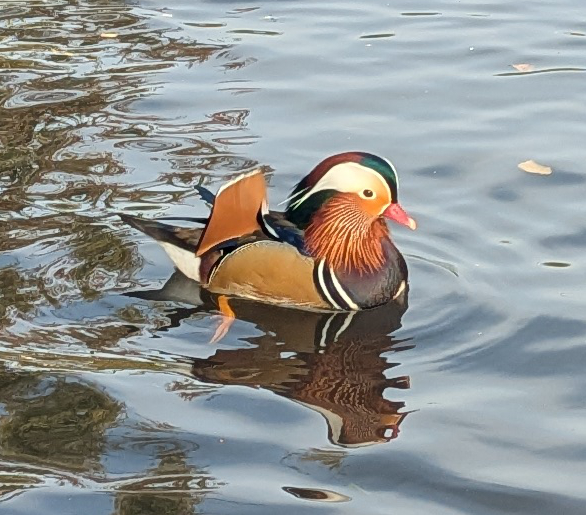
Name: Mandarin Duck
Latin Name: Aix galericulata
Most likely to be seen: The pond
Wildlife Spotter rating: Fairly easy
Did you know?
After the breeding season, the drake loses his bright colours for a few months and looks like the female, apart from his red-orange bill.
Do you have pictures of Mandarin ducks in the park that we could use? If so, please contact us.
If a duck on the pond looks as though an artist has painted it, you have probably found a Mandarin Duck. The male (the drake) is a showstopper. He has a swept-back crest of copper and white, a chestnut “whisker” on each cheek, and two orange “sails” that stand up from his back like tiny fins. He is smaller than a mallard, at about 41 to 49 centimetres long. In 2026, we have recorded only a single male at the pond.
This is not a British duck. The Mandarin is native to East Asia, including eastern Russia, China, Korea and Japan. It was first brought to Britain in the mid-1700s to decorate ornamental lakes and private collections. The wild birds we see today are descended from escapes and releases in the early 20th century, mostly around Surrey and Berkshire. They have spread since then, and there are now around 4,400 breeding pairs across the UK. Numbers grew by 663% between 1995 and 2024. As a non-native species, the Mandarin has no conservation status here, but it does not seem to harm our native wildlife.
It is also a rather unusual duck. Mandarins are “perching ducks”, so they are happy sitting on branches. They nest in tree holes, sometimes in old woodpecker holes, and their favourite food is acorns. They also eat seeds, water plants and snails. That makes mature oaks and overhanging trees by the water very valuable to them.
The drake’s look changes with the seasons. The female stays grey-brown all year, with a white ring around her eye. He is back in full colour by autumn and keeps it through the winter and spring, which is the best time to spot him.
Wild Mandarin Ducks in Asia have declined, and the world population is only around 65,000 birds. So the birds in the UK are quite important to the species.
NO DOGS ALLOWED
Please note: Dogs are not allowed in the fenced area around the pond; this helps protect the wildlife in this area from accidental harm or stress. It also gives people who may not be as confident around dogs a safe space to sit and enjoy the park.