

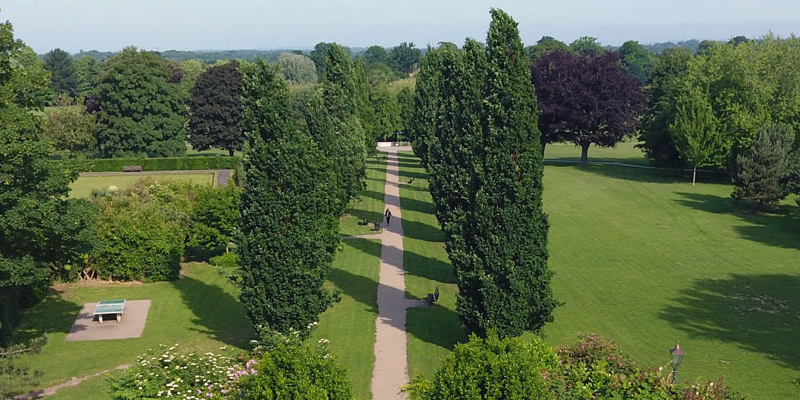
If you’ve walked the path from Park House Garden to the pond recently, you may have noticed that the row of tall, slender trees lining the route isn’t looking its best. That’s not your imagination. The avenue of Fastigiate oaks is in decline, and the park is in the process of replacing it.
The oaks were planted in the 1980s and they’ve been a familiar feature of the park ever since. However, over time, a structural weakness has developed where the branches meet the trunk. Several trees have needed bracing. Two have already been felled. The sad reality is that all of them are expected to need removing within the next five years.
Rather than wait for that to happen, Horsham District Council began work in early 2026 to plan for what comes next. The approach is a gradual one. New trees have been planted in between the existing oaks, so that a replacement avenue can grow while the old one is still standing. When the time comes, the oaks will be removed selectively, not all at once, to keep some sense of the avenue while the new trees find their feet.
Replacement Hornbeams
The replacement tree is the native Hornbeam (Carpinus betulus). It’s a tough, long-lived tree that suits the park well. It handles the clay soil, copes with both drought and waterlogging, and is less likely to suffer storm damage than the oaks it’s replacing. It’s also genuinely beautiful across the seasons; golden-yellow leaves that often linger through winter, vivid orange and yellow in autumn, and smooth grey bark that has an almost silvery quality in low light.
Hornbeams are also excellent for wildlife. The dense foliage provides cover for nesting birds. The seeds, catkins and nuts are food sources for birds, mammals and insects. Hornbeams are also great carbon capturers too; each tree can absorb and store an estimated six tonnes of carbon over its lifetime. With 20 young Hornbeams that’s 120 tonnes of carbon captured! You can find out more about the Hornbeam on the Woodland Trust website .
There’s a local history angle as well. Hornbeams played an important role in the Wealden iron industry that shaped much of the Horsham landscape. Planting them in the park is a small nod to that heritage.
The new trees are around three metres tall and approximately three years old. They’ll be supported with watering bags and tree guards while they establish. Hornbeams are slow to make their mark; it may be ten years before the new avenue reaches a recognisable height of around ten metres. But when fully grown, they can live for more than 150 years.
It will look different for a while. That’s unavoidable. But the aim is a resilient, lasting avenue that future generations of park visitors will enjoy just as much as we’ve enjoyed the oaks.