

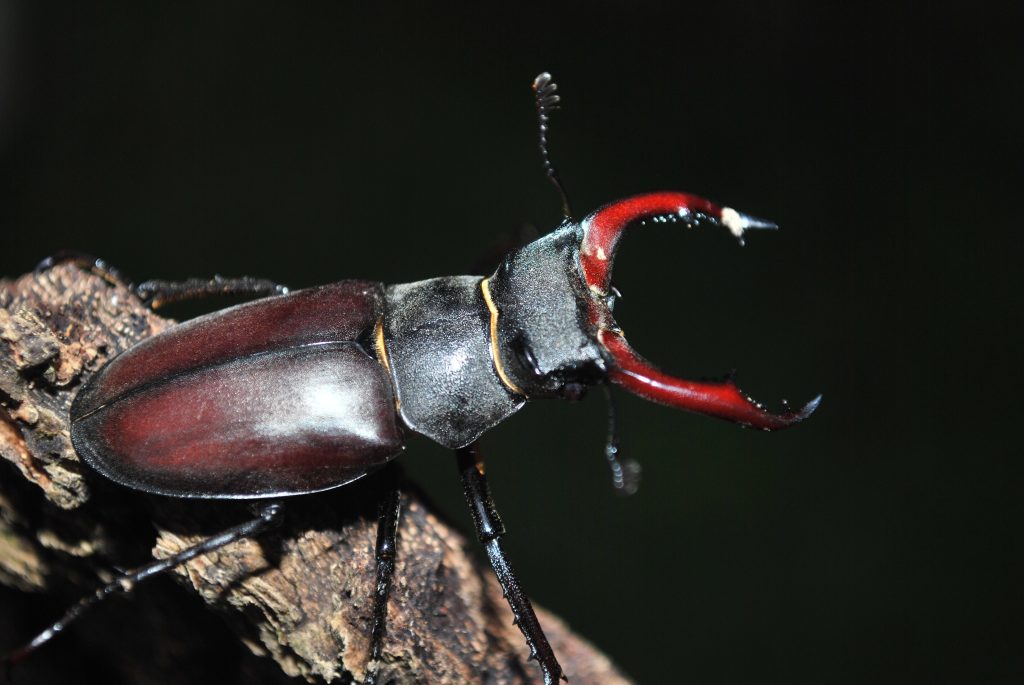
Name: Stag beetle
Latin Name: Lucanus cervus
Where to see in the park: May evenings on tree trunks or flying about.
Wildlife Spotter rating: Very difficult / Expert
Did you know?
At up to 7.5cm stag beetles are the largest beetles in Europe!
Do you have any pictures of Stag beetles in the park that we could use? If so, please contact us.
Stag beetles may look formidable with their unmistakable jaws, but they’re actually slow, gentle giants.
Females are about the same size as males, usually 3–5 cm long. Males look larger because of their long, antler‑like jaws, which can bring them up to 7.5 cm making them the largest beetles in Europe. Even though their jaws look fierce, they aren’t used for biting. Males use them to push and lift rivals when trying to impress a female.
After mating, females lay their eggs in rotting wood, often around woodland edges, parks and hedgerows. The eggs hatch after about three weeks, and the larvae feed on decaying wood, helping return valuable nutrients to the soil. This is one reason we leave log piles in the park.
Larvae remain underground for at least three years, sometimes up to seven, before pupating. Adults emerge in May, spending their short lives (only a few weeks) basking in the sun, feeding on tree sap and gathering strength before taking to the air, a little noisily and a little clumsily, to find a mate.
Stag beetles are a protected species in the UK, with numbers declining rapidly. Protecting their habitats is essential.
How to be a Stag beetle supporter
To help stag beetles you can:
- Look, don’t touch: If you see a stag beetle, you should appreciate how lucky you are, but don’t pick it up – they’re harmless but delicate.
- Build a log pile: Put some old logs in a shady corner as stag beetles need rotting wood to grow.
- Leave tree trunks and fallen branches: If it’s safe, let old wood stay where it is so larvae can feed.
- Avoid chemical pesticides: Pesticides can harm beetles and other helpful insects.